 Skip to content


HR compliance has always required vigilance. That will never change.
But today, the pace and scale of regulatory updates at the local, state and federal levels have transformed compliance into an ongoing operational challenge. How do you keep up? And how many small and medium-sized businesses (SMBs) are wondering the very same thing each and every day?
As an HR outsourcer you see your clients’ compliance concerns, and you know what they’re going through because you feel it, too.
Navigating complex labor laws should not be a guessing game; the stakes are just too high.
That’s why PrismHR’s HR Compliance is designed to give you and your clients peace of mind while giving you back something just as important—time to continue to focus on your business.
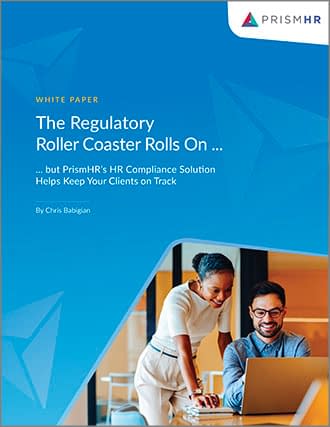
The regulatory roller coaster rolls on, but PrismHR’s HR Compliance helps keep you on track. Download the new white paper to learn more.
The Hidden Complexity Behind ‘Everyday’ Laws
Consider just one familiar area: wage and leave laws. Minimum wage increases, paid sick leave mandates, predictive scheduling ordinances, posting requirements and expanded worker protections are being enacted every year—often with little uniformity across jurisdictions. What applies in one city may not apply in the neighboring county. What was compliant last quarter may already be outdated today.
For employers, especially those operating in multiple locations, this creates a growing risk: even well‑intentioned businesses can fall out of compliance simply because the rules moved faster than their processes.
Wage and leave laws are viewed as foundational HR requirements. Most employers realize they must pay at least minimum wage, post required notices and offer certain types of leave. The challenge lies in the details.
For example:
- Minimum wage rates can differ by state, county or city, and may increase automatically on an annual schedule. For instance, California’s minimum wage increased to $16.90 per hour Jan. 1, 2026, but Berkeley, California’s minimum wage was increased to $19.18 per hour on July 1, 2025. Federal minimum wage, of course, is still stuck on $7.25 per hour as it has been since 2009.
- Paid leave laws vary widely, too, in terms of accrual rates, usage rules, carryover limits and employee eligibility. For example, Oregon has a maximum weekly benefit of $1,636.56 for Paid Family Leave with 12 weeks off plus two extra weeks for pregnancy while states like Georgia, Idaho and others do not have any in force.
- Overtime rules are also all over the place. California nonexempt employees get 1.5 times their salaries for working more than eight hours in a day or 40 hours in a week, for instance. In Colorado, the 1.5 times rate doesn’t kick in until 12 hours but the 40-hours-in-a-week threshold is still in play.
Add remote work and multistate payroll into the equation, and what once felt manageable becomes a full‑time effort. Tracking this volume of change manually is not only inefficient, but also extremely time-consuming and difficult—risky, too.
The Role of HR Outsourcers as Compliance Partners
For HR outsourcers (HROs), this challenge presents both responsibility and opportunity.
Clients rely on their HR partners not just to administer payroll and benefits, but also to help them navigate regulatory uncertainty with confidence. That expectation has grown as compliance has become more complex and more consequential.
For example, the maximum Occupational Safety and Health Administration (OSHA) penalty for a serious violation is $16,550.
The most effective HROs are shifting from reactive support to proactive compliance guidance through automation and advanced technology.
How Advanced Technology Supports Smarter Compliance
Technology plays a critical role in bridging the gap between regulatory complexity and practical execution—without replacing legal counsel or human judgment.
A state-of-the-art compliance platform can:
- Monitor regulatory changes across jurisdictions.
- Deliver timely alerts tied to specific locations and issues.
- Translate legal updates into actionable tasks and deadlines.
- Centralize documentation, policies and compliance calendars.
- Support onboarding, classification and posting requirements consistently.
For HROs managing multiple clients in multiple states, this kind of systematized approach helps reduce noise, improve accuracy and ensure nothing slips through the cracks.
Turning Compliance Into a Continuous Process
When compliance is embedded into daily workflows—rather than treated as a separate project—organizations are better positioned to adapt. Updates become manageable. Decisions become defensible. Clients gain peace of mind knowing their HR foundation is steady even as regulations shift around them.
For HROs, this means having the right tools to support that continuity that are designed specifically for the realities of HR compliance, from wage and leave laws to onboarding, worker classification and beyond.
Learn More
Staying ahead of ever‑changing employment regulations doesn’t have to feel like an uphill climb. To explore how HR outsourcers can more effectively manage compliance across jurisdictions using modern technology, download the PrismHR HR Compliance white paper and learn more about the new solution designed to help keep clients on track.
After all, keeping up with HR compliance has never been harder—and now easier with the right tools in play.


